What Is an F1 Pit Stop? Tyres, Strategy and Teamwork
A Formula 1 pit stop is a brief stop in the pit lane where a car receives service, most commonly a tyre change. From the grandstands, it can look like a few seconds of wheel work. In reality, the stop is one part of a larger race plan: the team has to decide when to call the car in, prepare its crew, carry out the work safely and send the driver back into the race in a useful position. Understanding those steps makes a pit stop easier to follow than simply watching the clock.
What does “pit stop” mean?
“Pit” refers to the area beside the circuit that contains the pit lane and team working spaces; “stop” describes the car pausing there for service. The driver leaves the racing circuit through the pit entry and follows the pit lane to the team’s designated working position. The pit lane is separate from the racing line and has its own operating rules. The car must reach its stop point under control, and the crew works around it while the driver remains in the cockpit.
Commentators may say that a driver is “coming into the pits” when the car begins to enter the pit lane. The actual stop happens after the car reaches its working position, and the pit visit is not over until it has been released and rejoins the pit lane. These distinctions matter when following a live race: the visible wheel change is only one stage between the decision to pit and the car’s return to the circuit.
What happens during a tyre change?
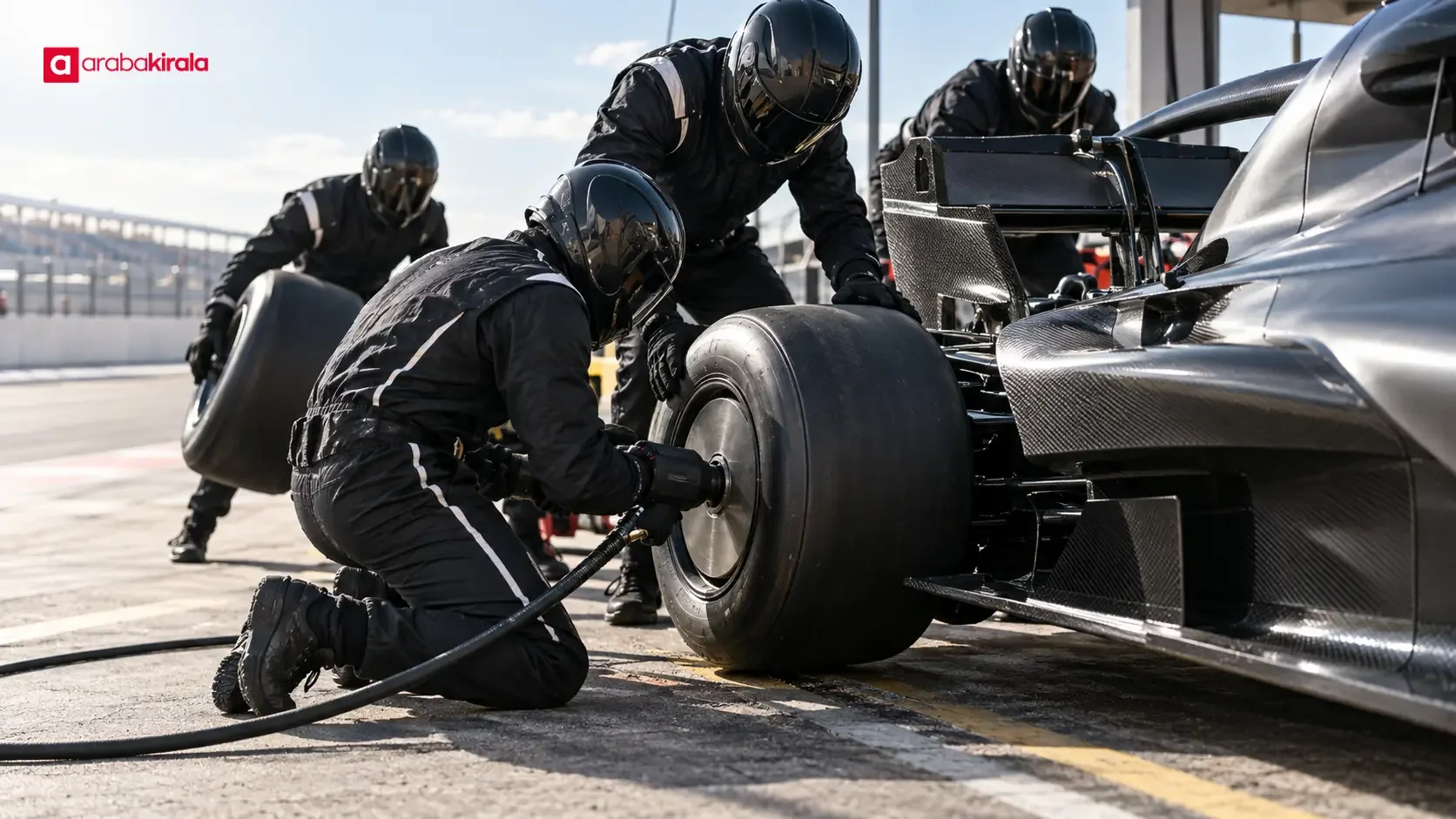
For a routine tyre change, crew members take up their positions before the car arrives. Once it is stationary, lifting equipment raises the car, allowing workers at the four corners to remove the old wheels and fit replacements. Special wheel equipment is used to undo and fasten the wheel nuts. The actions happen in parallel, so each corner can be worked on at the same time rather than one after another.
That choreography depends on clear roles and careful preparation. Each person needs to know where to stand, which task to perform and how to move without obstructing a teammate. Replacement wheels and tools are ready in advance. The crew must keep safe working space as the car approaches and avoid moving into the path of other cars in the pit lane. If a wheel or tool does not behave as expected, resolving the problem correctly takes priority over rushing the release.
Tyres are not the only possible work at a stop. Depending on what the car needs and what the rules allow, a team may make an adjustment or replace a damaged part. These are not automatic parts of every visit. The purpose and scope of a stop can vary, so two cars entering the pit lane at similar times may be there for different reasons.
How do teams decide when to pit?
The strategy group and engineers monitor information from the car, the driver and the developing race. Tyre performance changes as a stint progresses, and the driver’s feedback can help explain what the data shows. Teams also consider lap times, nearby traffic, the cars they are racing and the likely position after the stop. A pit call is therefore not made just by counting how many laps a tyre has completed.
A pit window is the period in which a stop is being considered as part of a team’s plan. It is a strategic range, not a fixed lap number that applies to every car or circuit. A team might choose to stop earlier to put fresh tyres on the car, or stay out to protect track position and use the current tyres for longer. The value of either choice depends on how quickly the replacement tyres work, what traffic the car will encounter and how much of the race remains.
Strategy staff at the pit wall weigh these factors and communicate with the driver. The driver’s view from the cockpit is valuable, especially when grip is changing, while the team can compare information across the race and assess where other cars are. The final call combines these different perspectives. An apparently obvious moment to stop may be less attractive if the car would rejoin behind a group of slower traffic.
Why do tyre choices affect a pit stop?
F1 has tyre types suited to dry, intermediate and wet conditions. Dry-weather tyres also come in compounds with different performance and durability characteristics. A compound that offers strong pace in a particular situation may not maintain that performance as long as another option. A more durable choice can provide a different balance. Actual behaviour depends on factors such as track temperature, surface, car setup and driving style, so a tyre that suits one race situation may not be the best choice in another.
Teams build a plan using information gathered before the race and revise it as conditions unfold. Wear, tyre temperature, lap times and driver feedback can all change the expected value of a stop. A car at the front does not automatically have an easy decision: it may return to the track behind traffic, while a car behind it may be able to stay out and run clear laps. The order in which cars stop can matter as much as the tyre selected.
Undercut and overcut: what is the difference?
An undercut is an attempt to gain a position by stopping before a rival and using fresh tyres to set quicker laps while that rival remains on track. If the driver can build enough time before the rival stops, the early-stopping car may emerge ahead when both have completed their pit visits. For this to work, the new tyres need to perform promptly and the car must avoid losing too much time in traffic after rejoining. It is a tactical option, not a guaranteed way to pass.
An overcut is the opposite timing approach: a driver stays out after a rival has stopped and tries to gain time on the current tyres before making their own stop. It may be attractive if the driver can produce strong laps, the rival takes time to bring new tyres up to performance, or the pit exit would place that rival in traffic. Staying out also carries a risk: the current tyres may lose pace, and the gap can grow before the stop is made. The better choice depends on the car’s pace, track position and conditions at that moment.
Does a faster stop always mean a better pit stop?
The time the car is stationary is only one measure. Total time lost during a pit visit also includes the route through the pit lane, the applicable speed limit and the time needed to rejoin racing speed. A very quick wheel change does not by itself show how much a team gained or lost relative to its rivals. To judge the effect, it helps to look at the car’s position before and after the stop, its lap pace and the traffic around it.
Speed also has to come with a safe release. The car must be properly supported while the crew works, the wheels must be secured and the area around the car must be clear enough for it to move. Pit lanes contain other cars and personnel, so a release at the wrong moment can create a serious hazard. The team’s release signal is a key part of the operation: the driver should leave only when the work is complete and the path is safe.
Who is involved in a pit stop?
The tyre changers are the most visible members of the crew, but other people help lift and stabilise the car and manage its release. Defined roles reduce hesitation and prevent team members from crossing into one another’s working space. Away from the car, strategists and engineers follow the race from the pit wall, update the plan and communicate with the driver. These are related but distinct jobs: the crew performs the physical work, while the pit wall contributes to the decision and information flow.
Practice helps a crew coordinate movements, anticipate what teammates will do and respond when something goes wrong. Repetition is not only about reducing time; it supports consistency and clear reactions under pressure. If there is a delay at one corner, the car may have to remain stopped until the work is complete. A release signal does not replace the work itself: it indicates that the team has checked that the car can be sent safely.
How can a safety car affect pit strategy?
A safety car or another period of reduced speed changes the time gaps between cars and can alter the cost of making a pit stop. A stop during such a period may be more attractive than one under ordinary racing conditions, but the value depends on the car’s location, its rivals and the remaining race. The safety car does not give every driver an identical advantage. The timing of the stop and the order of the cars on the circuit still matter.
Weather can also change the calculation. Rain may make a dry-weather tyre unsuitable for the available grip, while a drying surface can change how well a wet-weather tyre performs. The team has to assess how conditions are evolving, and the driver’s experience of grip can complement information from the pit wall. A quick change in weather may make the timing of a stop especially important, but there is no single answer that applies to every circuit or race.
What should you watch when following a pit stop?
- Check the gaps before the stop: The distance to nearby cars helps explain whether traffic could affect the driver’s return to the circuit.
- Notice the tyre type: The replacement tyre offers a clue about how the team sees the current conditions and the remaining race.
- Follow the whole pit visit: Look beyond the wheel change to the pit lane time and the position in which the car rejoins.
- Connect the driver’s feedback with the team’s view: Grip reports, lap pace and traffic information all contribute to the strategy.
When comparing pit stop times, check what the displayed measure includes. One figure may cover only the time the car is stationary; another may span the visit from pit entry to exit. These numbers describe different parts of the process. Neither alone proves that a team has gained or lost a position. The surrounding lap times and the stop sequence help make the result clearer.
Frequently asked questions
Do F1 cars always change tyres during a pit stop?
Tyre changes are a common reason to stop, but the work can vary with the car’s needs and the operations allowed by the rules. Some stops may involve other work, so not every visit has exactly the same purpose.
Why can a pit stop take only a few seconds?
The crew prepares in advance, divides the tasks and works on the wheels at the same time. Regular practice helps make those movements coordinated. The car still has to be checked and released safely before the driver can return to the pit lane.
Can the fastest pit stop win a race?
A quick stop can help, but it does not decide a race on its own. Tyre performance, lap pace, traffic, track position and other strategic choices all influence the outcome. A short stop may not be useful if the car rejoins in a difficult position.
Is a pit window a specific lap number?
No. It is the part of a strategy in which a team is considering a stop. Its timing changes with race conditions and the team’s plan.
What is the main difference between an undercut and an overcut?
With an undercut, a driver stops before a rival and tries to gain time on new tyres. With an overcut, the driver stays out after the rival stops and tries to gain time before making their own stop. Traffic, tyre behaviour and pace determine which approach is more promising.
To understand an F1 pit stop, look beyond the seconds spent changing wheels. The reason for the stop, the tyres selected and the traffic the car faces on its return all help explain its effect. A pit stop brings together mechanical skill, strategic judgement and teamwork in a short but consequential part of a race.
Legal Disclaimer: All content, articles and information on the Araba Kirala website are provided solely to inform users. No information shared on this website constitutes definitive advice or guidance. Araba Kirala Teknoloji A.Ş. and its authors cannot be held responsible for any direct or indirect damages arising from the application of information on the website. For all questions and requests regarding car rental, please contact the office from which you will rent your vehicle.