
How Does Hill Start Assist Work? Systems Explained
Published: October 17, 2026 • Reading Time: 7 min • Last Updated: October 17, 2026
Learn how hill start assist briefly holds the brakes during a hill start, how it differs from ABS, ESC and Auto Hold, and what to check before driving a rental car.
Contents
- What is hill start assist?
- How does the system work?
- How it differs from ABS, ESC and Auto Hold
- What does ABS do?
- How is ESC different?
- Is Auto Hold the same as hill start assist?
- What the driver does in manual and automatic cars
- Limits and safe use
- Checking the feature in a rental car
- Summary and next step
- Frequently Asked Questions
Hill start assist helps limit a vehicle’s tendency to roll backward in the short interval between releasing the brake and moving off on an incline. This guide explains how hill start assist works, how it differs from ABS, ESC and Auto Hold, what the driver still needs to do, and what to check when collecting a rental car. It can make a start easier, but it does not take over control of the vehicle or the surroundings.
What is hill start assist?
Hill start assist is a driving support feature that may appear in a manual under names such as HSA, HAC or Hill Start Assist. When a vehicle is stopped on a slope, the feature can help manage the brief transition from braking to moving. Its purpose is to reduce the chance of rolling backward while starting uphill. Availability depends on the vehicle, model year and trim, so do not assume every car has it.
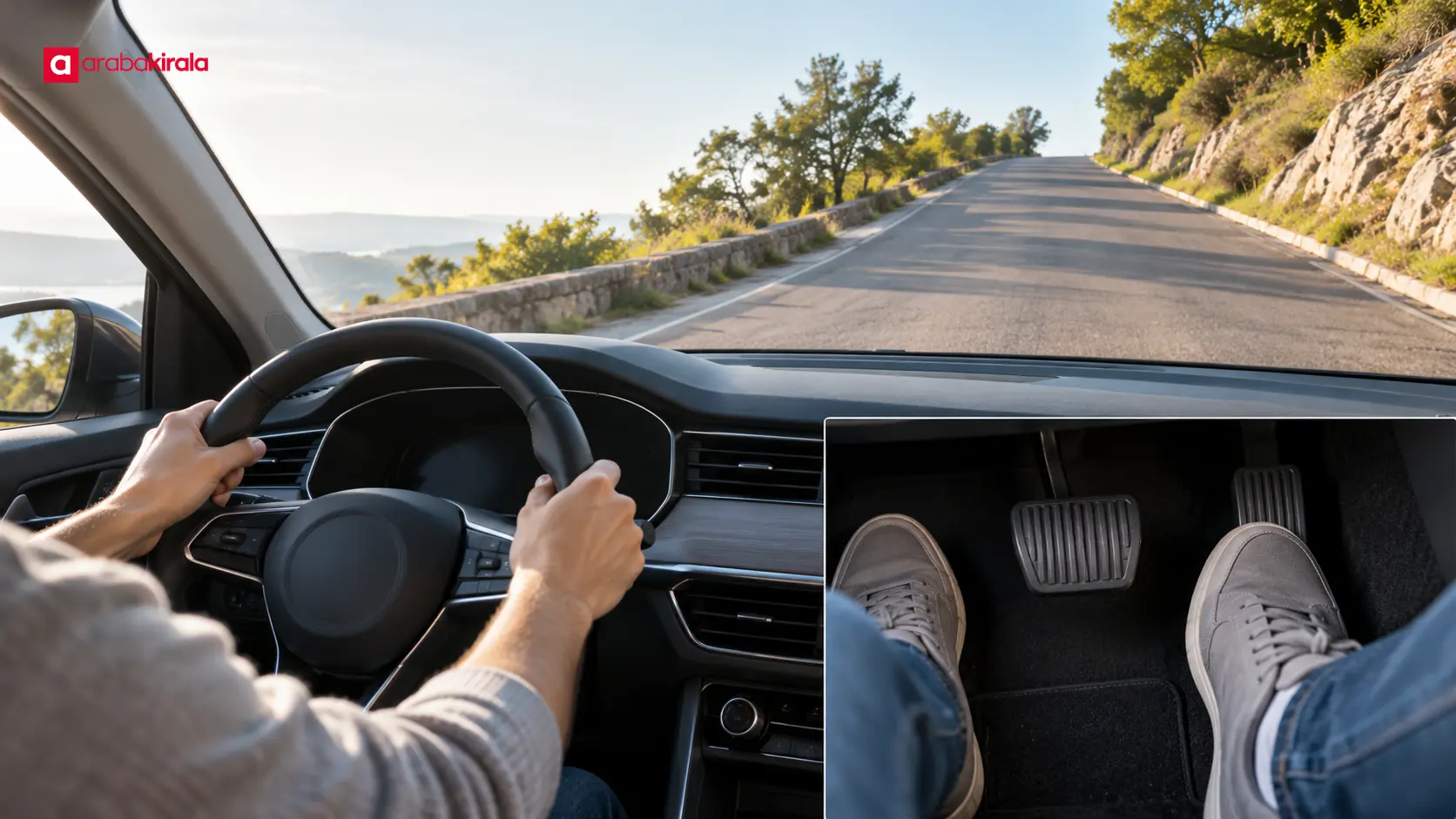
On a slope, gravity tends to move a stationary vehicle downhill. A driver may need to move a foot from the brake to the accelerator, or coordinate the clutch and accelerator in a manual car. During that transition, the vehicle may begin to move before the drivetrain produces enough forward force. If the vehicle detects the relevant conditions, hill start assist can temporarily maintain brake pressure so the driver has a moment to begin the start.
How does the system work?
Hill start assist is not necessarily a separate mechanical latch. It usually works through the vehicle’s electronic controls, braking system and sensor signals. The exact design differs by vehicle, but the general process can be described in a few stages:
- The vehicle detects a stop and incline: Wheel speed and other signals that help determine vehicle movement or orientation are evaluated. Vehicles do not all use the same sensors or activation thresholds.
- Operating conditions are checked: Gear selection, brake pedal use, parking brake status and system readiness can affect activation. The owner’s manual gives the conditions for that specific vehicle.
- Brake pressure is held briefly: After the driver releases the brake pedal, electronic brake control may temporarily maintain pressure at the wheel brakes. This helps keep the car still during the transition.
- The brakes release as the car moves off: The system reduces brake pressure when it detects a starting action, such as accelerator or clutch input, or when its vehicle-specific hold interval ends.
The hold interval and the way the feature activates or releases vary by manufacturer, model, equipment and operating conditions. A particular number of seconds, slope percentage or pedal sequence should not be treated as universal. Use the vehicle’s own manual for its instructions.
How it differs from ABS, ESC and Auto Hold
What does ABS do?
Anti-lock braking system (ABS) helps reduce wheel lock during hard braking, supporting the driver’s ability to steer while braking. Hill start assist has a different focus: it helps prevent rollback during the transition from a stop to moving off. The two features may use parts of the same electronic braking hardware, but they do not perform the same job.
How is ESC different?
Electronic stability control (ESC, sometimes called ESP) can respond to conditions such as a loss of grip or a vehicle path that differs from the driver’s steering input. Depending on the design, it may intervene through braking or power delivery. Hill start assist is focused on the brief moment of a start on a slope. Both functions can be present in one vehicle and may share sensors or brake components, but one does not replace the other. A warning light or system fault can also affect operation.
Is Auto Hold the same as hill start assist?
No. When enabled and when its conditions are met, Auto Hold can maintain braking after the vehicle has stopped, including during a wait in traffic. The release behavior depends on the vehicle. Hill start assist is generally a shorter intervention intended to help with the move-off transition. The parking brake is another distinct system, designed to secure a parked vehicle. Do not use hill start assist as a way to hold a vehicle for a long wait or to park.

What the driver does in manual and automatic cars
In a manual car, the driver still coordinates the clutch bite point, accelerator and surrounding traffic. Hill start assist may reduce the short gap between releasing the brake and generating drive through the clutch. It does not replace learning clutch control or choosing an appropriate throttle input. Be ready to use the pedals if the car moves unexpectedly.
In an automatic car, moving off often involves changing from the brake pedal to the accelerator, but gear selection and system behavior depend on the vehicle. Some cars activate the feature automatically when conditions are right; others provide an indicator or setting. Check the owner’s manual to confirm that the car has the feature and to learn how it behaves.
Limits and safe use
Hill start assist does not guarantee that a vehicle will remain still on a slope indefinitely. Its hold interval may be short, and the result can depend on incline, surface grip, vehicle load, brake condition and other operating factors. On wet, icy, gravel or loose surfaces, limited tire grip cannot be corrected by temporarily holding the brakes. The feature does not remove the need to leave a safe gap or make a controlled start.
- Before driving, check the vehicle manual for whether hill start assist is fitted and how its indicator appears.
- Before moving off, confirm the selected gear and check for pedestrians and other vehicles around you.
- When releasing the brake, observe the vehicle. Do not assume the system is holding it while keeping your feet away from the pedals.
- Use controlled pedal inputs suited to the vehicle. The feature cannot make sudden acceleration or an inattentive maneuver safe.
- If the dashboard shows a brake, stability control or driver-assist fault, follow the manual and stop somewhere safe.
- When parking, use the appropriate parking brake and gear selection. Do not leave the car relying on a temporary hill-start function.
Checking the feature in a rental car
Rental vehicles can differ in model and equipment, so confirm whether the particular car has hill start assist. Ask the branch where you are collecting the vehicle whether it is fitted and how to recognize its indicator. Once you know the model and model year, look in the in-car manual for “hill start,” “HAC” or a similar heading. If you are unsure how it operates, ask for an explanation before driving into busy traffic or onto a steep hill.
At collection, it is also useful to familiarize yourself with the brake pedal feel, dashboard warnings and any driver-assistance settings. These checks help you understand the vehicle interface; they are not a diagnosis of the car’s condition. If a warning or unusual brake behavior appears, report it to the branch before setting off. For equipment details and instructions specific to the vehicle, contact the branch you are renting from.
Summary and next step
Hill start assist helps reduce rollback by briefly maintaining brake pressure as the driver moves off. ABS addresses wheel lock during braking; ESC addresses stability; Auto Hold can maintain braking during a stop; and the parking brake secures a parked vehicle. These functions are not interchangeable. Before driving, read the vehicle’s instructions, confirm the equipment with the rental branch and remain responsible for controlling every start.

Frequently Asked Questions
Does every car have hill start assist?
No. Availability depends on the vehicle, model year and equipment. Check the car’s manual or ask the branch where you are collecting it to confirm the feature is fitted.
How long does hill start assist hold the car?
There is no single duration that applies to every vehicle. The interval and release conditions depend on the manufacturer’s design. Consult the vehicle manual and do not use the feature for parking or a prolonged wait.
Is hill start assist the same as Auto Hold?
No. Hill start assist usually supports the short transition into a start, while Auto Hold is a separate feature that can maintain braking during a stop when enabled and conditions allow. Their operation varies by vehicle.
Can a car still roll backward when hill start assist is fitted?
The feature works for a limited time and only when its conditions are met, so it cannot be relied on to prevent every movement. A steep slope, poor grip or a system warning can affect its operation. Keep controlling the pedals.
Can I drive if hill start assist has a fault?
A fault in this feature alone does not establish the condition of the entire vehicle. If a brake or stability warning appears, follow the owner’s manual and stop safely. In a rental car, report the warning to the branch and ask for vehicle-specific guidance.
Legal Disclaimer: All content, articles and information on the Araba Kirala website are provided solely to inform users. No information shared on this website constitutes definitive advice or guidance. Araba Kirala Teknoloji A.Ş. and its authors cannot be held responsible for any direct or indirect damages arising from the application of information on the website. For all questions and requests regarding car rental, please contact the office from which you will rent your vehicle.












